3
Basic Principals of All Table Tennis Strokes
by Richard McAfee
This
column discusses the use of a table tennis robot in learning ping pong
strokes, styles, and techniques. Richard McAfee is one of America’s
most active and recognized coaches. Certified as an International Coach
by USA Table Tennis, he was selected as a USOC (US Olympic Committee)
Developmental Coach of the Year. He organized and directed the Eastern
Table Tennis Training Center and the Anderson College Table Tennis Team.
He served as the Table Tennis Competition Manager for the 1996 Summer
Olympics and recently was selected as an ITTF (International Table Tennis
Federation) Pro Tour Director. Currently he is Head Table Tennis Coach
at the prestigious Sporting Club At Windy Hill in Atlanta, GA.
This
article is unique because the information it contains impacts every
stroke in the game. These concepts cut across all differences in grips,
playing style, and personal technique. Strict adherence to these principals
is necessary for any individual stroke to be successful.
1.
Timing—When To Touch The Ball
•There are three possible timing possibilities
-As the ball is rising
-At the top of the bounce
-As the ball is descending
| STROKE
TIMING (Changes according to type of ball being struck.) |
|||
|
Stroke |
TIMING |
||
| Rising |
Top |
Falling |
|
|
Counter |
• |
• |
|
|
Fast Loop |
|
• |
|
|
Slow Loop |
|
• |
• |
|
Reloop Off Bounce |
• |
|
|
|
Reloop, Mid-Range |
|
• |
• |
|
Push, Normal |
|
• |
• |
|
Push, Fast |
• |
|
|
|
Chop |
|
|
• |
|
Block Against Loop |
• |
|
|
2.
Application of Force and Friction—How to Touch the Ball
•Force contact occurs when a forward moving racket strikes
the ball. An example of this occurs when you bounce the ball straight
into the air on the racket.
-You can often hear a “wood” type of sound
(hard sound)
-Most of the energy goes into producing forward motion.
•Friction contact occurs when you brush the ball with
the racket.
-Most of the energy goes into producing spin (ball rotation)
-Sound is muffled (soft sound)
•Most strokes are a blend of Force and Friction.
-Slow Loops, serves, and pushes are maximum friction
and minimum force.
-Fast Loops are medium Force and medium Friction.
-Counters and Kill shots are maximum Force and minimum
Friction.
| DIRECTION OF STROKE FORCE (Changes according to type of ball being struck.) |
|
|
Type
of Incoming Ball |
Stroke
Direction |
| Against Topspin | Down
& Forward |
|
Against
Backspin |
Up
& Forward |
|
Against
Right Sidespin |
To
Your Left & Forward |
|
Against
Left Sidespin |
To
Your Right & Forward |
|
Against
a High Ball |
Downward |
|
Against
a Low Ball |
Upward |
3.
Ball Contact—Where to Touch the Ball
•Most important of the 3 principals.
•Always contact the Front of the ball.
-Front of the ball is an area, not a specific point.
-Front of the ball is a constantly changing area, determined by the trajectory of the ball.
–It is the part of the ball facing the direction
of travel.
AREA OF CONTACT FOR VARIOUS STROKES(Changes according to type of ball being struck.) |
|
|
Stroke |
Contact
Area On Ball |
|
Counter
Against Topspin |
Above
Center |
|
Kill
Against Backspin |
Center |
|
Slow
Loop Against Backspin |
Center |
|
Fast
Loop Against Backspin |
Center
Or Above Center |
|
Reloop
From Mid-Distance |
Center
Or Below Center |
|
Reloop
From Close To Table |
Top |
|
Push
Against Backspin |
Below
Center |
|
Chop
Against Topspin |
Center
Or Below Center |
Definition of "Front" and "Center" of Ball
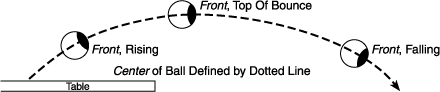
Relationship
Between the “Front” of the Ball and Stroke Timing
The
area of the ball facing the direction of travel defines the “Front”
of the ball. The Front does not change even if the ball is spinning.
When you are aiming for a spot on the ball you must also consider the
stroke timing that you are using.
Here
is an example of how the contact point on the ball will change with
the timing you use. Let’s assume that your opponent chops a ball
to your forehand that you wish to loop. According to the chart on where
to contact the ball for this stroke, the contact should be below the
center of the “front” of the ball. Now look above at where
that point on the ball would be when the ball is struck at the top of
the bounce. Now compare how that location would change if you let the
ball fall. You can see how your racket angle would have to change as
your timing changes.