|
|
|||
|
|


TABLE TENNIS
EQUIPMENT
There is an endless
variety of rackets, blades, and rubber sheets available.
It is beyond the scope of this manual to cover all the
different kinds. Therefore I recommend getting a racket
of good quality and medium price capable of producing all
the strokes discussed in this manual.
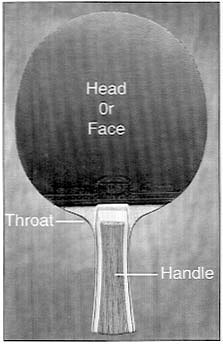
A racket is composed of two main parts-the blade or
wooden part, and the rubber covering on the face of the
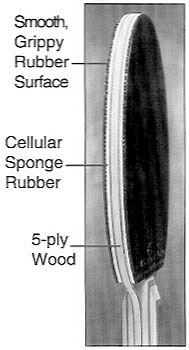
racket. Please look at Photos 1 & 2 on the next page.
According to official table tennis rules, the rubber
covering must be colored bright red on one side of the
blade and black on the other side. Plain wooden rackets
with no rubber covering and sandpaper rackets are both
prohibited. These types of rackets do not permit a player
to perform the strokes described in later sections, so
please use one of the recommended types.
If you have been using sandpaper, plain wood, or hard
rubber, a sponge rubber racket will feel heavy and
uncontrollable at first. By following the instructions in
this book, you will soon learn how to angle your new
racket correctly to compensate for spin and how to apply
your own spin to the ball.
Robo-Pong 2000 simulates playing with inverted sponge
rubber so you should be able to quickly adapt to your new
racket.
It is important to have your own racket and to take good
care of it. Look for a racket that is comfortable in your
hand and feels well-balanced and not too heavy or too
light. The fit of the handle in your hand is important.
Handles come in several shapes, so try out a variety of
shapes and sizes before deciding on one. The wood from
which the racket is made should be of medium stiffness,
such as basswood, willow, or birch. The blade should be
of 5-ply construction. A good starting blade would be the
Newgy Acclaim or the Newgy Applause.
The rubber is the next item to select. The most
versatile rubber, and therefore the one that I strongly
recommend for learning the basics, is inverted rubber.
Inverted (pips-in) rubber has a smooth, grippy surface on
top of a layer of dense cellular sponge (see Photo 2 ).
The smooth, grippy outer surface is the best surface for
applying spin to the ball. The underlying layer of sponge
rubber gives a catapult action to the ball and increases
the amount of speed that can be applied to the ball. This
is the rubber choice of 95% of all top players.
The rubber, such as Newgy Mercury or Omega, should be
rated medium in spin and speed, high in control, and be 1
1/2 millimeters thick. If these ratings are not displayed
on the package, you may need to ask the vendor for these
ratings. Look for the
ITTF logo on the rubber surface to assure that the
rubber is manufactured to ITTF specifications.
Be sure to keep your rubber clean by washing with soap
and water after every use and storing it in a protective
case. Dirty rubber does not play as consistently as clean
rubber.
Although you may buy preassembled rackets (blades with
rubber already attached), it’s much better to select the
blade and rubber separately and have the supplier glue
the rubber onto the blade. This way, you may replace the
rubber without also replacing the blade. The rubber on
most preassembled rackets is all but impossible to
remove. Your rubber should be replaced when the tackiness
of the surface is noticeably different between the center
of the racket where you frequently strike the ball and
the edge of the racket where you seldom hit the ball. If
you need additional help with equipment selection,
contact the Newgy Customer
Service Department.
When purchasing a table, look for a smooth, even surface
of 3/4″ thickness with a sturdy frame underneath. Your
net set should be made of cord and have top and bottom
strings for adjusting the net tension. Since the side
nets of Robo-Pong 2000 attach to your table net, having a
good net set is crucial to having the side nets function
correctly. Cheap plastic nets and flimsy net posts do not
offer enough support for the attachment of side nets. If
you have trouble finding good net sets locally, call Newgy
Customer Service.
When setting up your table, give yourself plenty of
playing room at the player’s end of the table. You need a
lot of space so your strokes will not be hampered and to
give yourself a sense of unrestricted movement. Also it
is helpful to keep your playing area clean and free of
objects that balls can roll under or into.
|
Photo 1: Table
Tennis Racket, Front
Typical table tennis racket with inverted rubber, front view |
 |
| Photo
2:Table Tennis Racket, Side
Typical table tennis racket with inverted rubber, side view. |
 |