The
Stages Of Athletic Development
by Richard McAfee
This
column discusses the use of a table tennis robot in learning ping pong strokes,
styles, and techniques. Richard McAfee is one of America’s most active and
recognized coaches. Certified as an International Coach by USA Table Tennis, he
was selected as a USOC (US Olympic Committee) Developmental Coach of the Year.
He organized and directed the Eastern Table Tennis Training Center and the
Anderson College Table Tennis Team. He served as the Table Tennis Competition
Manager for the 1996 Summer Olympics and recently was selected as an ITTF
(International Table Tennis Federation) Pro Tour Director. Currently he is Head
Table Tennis Coach at the prestigious Sporting Club At Windy Hill in Atlanta,
GA.
As
table tennis athletes progress in table tennis, they pass through very
definite stages of development. In order for students and their parents
to understand where they are in this process, I created a tool called
the “Table Tennis Pyramid of Success”. The Pyramid shows
the nine developmental stages that athletes go through in their journey
to becoming a complete player.
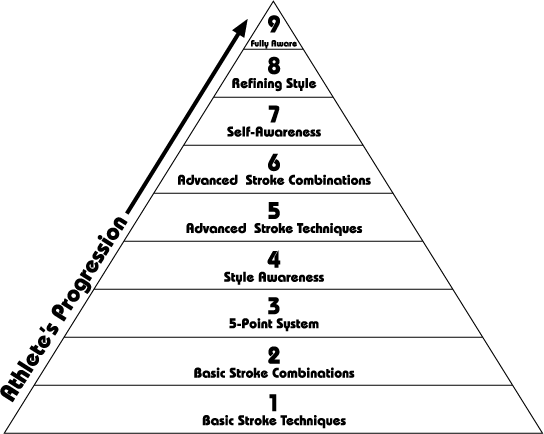
Table
Tennis Pyramid of Success
Stage 1 – Basic Stroke Technique
At
this stage, athletes are simply learning the fundamental techniques
of the game such as basic strokes, elementary spin theory, simple serve
and return, and the rules of the game.
Stage 2 – Basic Stroke Combinations
Once
the student can control the basic strokes, the coach then begins to
combine these strokes together to form combinations, bringing together
both forehand and backhand techniques. This combining of strokes also
requires that the student begin to move more, and lessons in footwork
start during this stage.
Stage 3 – The 5-Point System
When
the student can control the basic stroke combinations, the focus is
turned to learning how to play points. As most points in a game are
finished by the 5th stroke, the emphasis is placed on the
first 5 possible strokes of a game. As all points must begin with either
a serve or a return, these techniques are stressed during this stage.
Third and fifth ball attacks are introduced, as well as 4th
ball counter attacks or defense. The goal of this stage is to move the
student from thinking of executing one stroke at a time, into planning
out whole points.
Stage 4 – Style Awareness
During
stage three, the student’s natural style begins to express itself.
It can be seen in how the student chooses to begin putting their points
together. Does the student naturally prefer to hit rather than loop?
Does the student have natural early or late timing? Does the student
prefer to play close to the table or at mid-distance? These and other
telltale signs start to show as the student learns to play whole points.
During this stage, students are introduced to the basic styles of the
game through written materials and the use of videotapes. Students are
told to watch the better players at their table tennis club and place
these players into style categories. Finally, students write down a
complete description of what they want their style to become.
Stage 5 – Advanced Stroke Techniques
Now
that the student understands what their style will be, they must begin
to learn the advanced techniques necessary to complete that style. What
these techniques are will vary greatly from style to style. Pips-out
hitters, all-round topspin attackers, and choppers all need to learn
very different techniques. It is at this level that many athletes get
stuck and do not advance. While levels 1-4 can be reached with
a minimum of coaching assistance, Stage 5 really requires the personal
services of a competent coach.
Stage 6 – Advanced Stroke Combinations
Once
these advanced techniques are learned, they must be combined with the
student’s existing strokes and blended into the desired style
of play. During this stage, the 5-Point System is revisited and practiced
using the new combination of advanced strokes. Again, this stage requires
a lot of personal attention from the coach to keep the student on track.
Stage 7 – Self-Awareness
At
this stage, the athlete has all the physical tools necessary to execute
their desired style of play. The focus at this level of development
is on gaining match experience and learning how to use their style to
defeat opponents. As the athlete is still somewhat inexperienced, they
are focused more on what they are attempting to do than on what their
opponent is doing. The student has become self-aware but does not yet
focus outward towards their opponent.
Stage 8 – Refining Style
As
athletes begin to gather more and more match experience, they will continually
make small corrections and additions to their style of play. Ideally,
athletes will return to this stage over and over again throughout their
competitive life. When an athlete stops learning and improving their
game, their development is over.
Stage 9 – Full Awareness
This
is the stage of development that all athletes strive for. It is often
called “the peak experience”. During this stage, the athlete
is almost totally focused outside himself. Fully aware athletes often
report feelings of time moving slower, the ball appearing larger, and
feeling that they can do anything they want to with the ball. While
most athletes experience this “peak experience” at some
point in their lives, the fully aware athlete can reproduce this experience
much more often.
Important Points
Please
remember that an athlete’s development does not follow rigid,
set stages. Rather, it flows as a process with each athlete spending
more or less time in any one stage, as needed. Movement is not always
in an upward direction. Sometimes, an athlete will need to return to
a lower stage to correct some problem or learn material that was missed.
Most
coaches feel that it takes about ten years of training to take an athlete
to the top of their game. Hopefully, the Table Tennis Pyramid of Success
will give you a guide to understanding your own development in reaching
your goals. While many try to become champions, only a few actually
make it. For that reason, I always stress to students, “that
the quality of your journey is more important than your destination”.
COMING SOON—ATHLETE PROGRESSIONS!
Over the next few months, I will cover the individual skills and knowledge that an athlete needs to learn (progressions) to move from one level to another on the TABLE TENNIS PYRAMID OF SUCCESS.