Newgy’s Blog

Jonathon Lian Foothills X Gold Dollar Upset Open Table Tennis Tournament by Bill Neely

Filed under: Bill Neely,Table Tennis Tournaments/Results — by Jena N. on December 17, 2010 @ 4:28 pm

On Saturday November 13, the Knoxville Table Tennis Club hosted one of their better tournaments of the year, the Jonathon Lien Foothills X Gold Dollar Upset Open. This tournament was named in honor of a special young man, Jonathon Lian, the grand upset winner in the previous tournament, the Foothills IX Gambler Gold Dollar Upset Open. There were 18-upsets during this tournament.

The Upper divisions were characterized by play befitting that of National events. There were 9-players rated above 2000, some of whom could have been under rated judging from their play. The matchup in the final Championship round could not have been predicted.
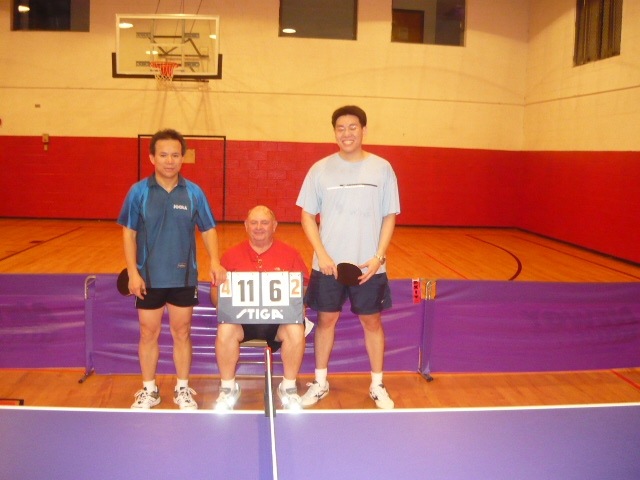
blog 3 pic In the end, however, the top seed, Richard Doverman from Potomac, Maryland prevailed over third seed, John Mar from Atlanta, Georgia. This final began at what appeared to be a walkthrough for Doverman, but that was not to be. After being down 2-0, Mar came back with blistering loops and smashes to win the third game at 4. From that point on, the games see-sawed, back and forth, with Doverman winning at 5, Mar at 4, and finally, Doverman took the seventh and final game at 11-6. (See Photo, Richard left, John right.) For their efforts Doverman and Mar rode off into the night with $500.00 and $300.00, respectively.

Yuichi Yageyama, after hard-fought losses, to John Mar, 7,-6,-9, 10, and -4, and to Richard Doverman -9,-5, and -9, won third place by defeating Liedy Handoko at 7, -7, -7, 8, and 5. Yuichi won $200.00 for his efforts.

Other great matches saw John Mar narrowly defeating Yevgeny Puzyrev at -8, -9, 9, 10, and 6: John Mar defeating Petro Stirbu at 7, -9, -9, 7, and 6: Richard Doverman defeating Liedy Handoko at -8, 5, 7, -5, and 9: Di Di De Souza defeated Slawomir Waclawik at-3, -5, 8, 9, and 7; and Slawomir Waclawik defeated Liedy Handoko -9, 8, 8, -7, and 7.

The other results were:

Division A: Jude Lam (Knoxville) 1st, Guido Schnable 2nd, Kui Zhang 3rd, and Yoshiyuki Okawa 4th. First, second, and third place players were money winners.

Division B: Tatiana Peskova 1st, Albert Zhang 2nd, Carl Bradley 3rd, and Roger Dickson 4th. Again first, second, and third place players were money winners.

Division C: Perry Smith 1st, Art Xu 2nd, Anene Onyemelukwe 3rd, and Kirin Kasichayanula (Knoxville) 4th.

Division D: Kathy McMillin (Knoxville) 1st, Josh Cook 2nd, John Edd Walker 3rd, and Manuel Dy 4th.

Division E: Archie Jordan (Knoxville) 1st, Jonathon Lian 2nd, Tim Roundtree 3rd, and Daniel Decker 4th.

First, second, and third place winners for Divisions C, D, and E won beautiful plaques designed by Kathy McMillin.

The “Winner-Take-All” winning doubles team was Petro Stirbu and Nick Broussard, each winning $107 for their wins.

Our thanks to Newgy, Zero-Pong, Horizons Avionics, Crown Plaza, and Phyllis Wheatley YWCA for their continued support and their part in making this event possible.

Bill Neely

The Importance of Footwork by Perry Wilson

Filed under: Perry Wilson,Table Tennis Tips — by Jena N. on December 7, 2010 @ 4:44 pm

In table tennis there are several important aspects. In my opinion the most important is footwork. I will tell you why it is important, and how to improve it.

Footwork is important in every point and every shot. You need to have your feet in the correct position if you want the most effective shot. If you do not get your feet where they need to be, then not only that shot will be a bad one, but then the rest of the point will not be good. Also, when you have your feet in the right place, then your shot can be more powerful and spinier. Then you can get your opponent out of position.

The second thing I want to show you is the way to have correct footwork. There are many different aspects to footwork that you must have. The first one is to always have your knees bent. If you do not have your knees bent, it will be so much harder to move your feet. Another important thing you need to know is where you last hit the ball. Most of the time the ball will be coming back diagonal from where you hit it to. So this will help you sort of predict where the ball will be coming. Finally, weight transfer is another very important thing. Without correct transfer of weight, your body will be off balance and it will ruin your entire game.

In conclusion, I believe if you work on improving those three areas of your footwork, your game will improve a lot, and will take you to the next level.

Perry Wilson

Improving your Serve by Pierce Scott

Filed under: Pierce Scott,Table Tennis Tips — by Jena N. on December 3, 2010 @ 4:16 pm

What starts off every single point? What shot do you have 100% control of? Your serve!

The best way to improve your table tennis game drastically is to improve your serves. If you can improve your serve, you can get into the point better and set up your way of playing. If you can practice your serve about five days a week for a focused 30 – 60 minutes, you can really boost your game.

The best way to practice serves is to pick one or two serves that go with each other. For example, you could just work on short heavy backspin to the forehand. Or you could work on short heavy backspin to the forehand and long fast topspin to the backhand. These two serves go together because you would use these as a combination in a table tennis match. Work on only these two serves for the training session. When you are serving, make sure you don’t lose focus. If you feel you are losing focus, then stop. There is nothing wrong with stopping — quality always wins over quantity when serving.

Another great way to improve your serves is to record yourself serving to look for certain things. You could be looking to see if they are legal, if they look the same as other serves or if they are deceiving. Watching yourself make the mistake is a lot easier to correct than having someone tell you about it and not know what was wrong.

To have an effective serve, you need to have varieties of serves you can use. The main varieties of serves you can have are short and spiny, long and fast, trick serves and dead balls. Short and spiny serves need to bounce twice on the opponent’s side if they weren’t touched. Long and fast serves need to hit within 3-5 inches of the white line at the end of the table. Also, a very useful serve that people often overlook is the dead ball. It can be served short or long. If you serve it short, make sure it double bounces. If you serve it long, a good place to serve it is to the backhand or the player’s middle. Normally a player’s middle is at their elbow. The benefit from serving a long, fast and dead ball serve is normally the opponent is surprised when you serve long and fast so they try to block it on. If you give them a dead ball they will have to create their own spin to get the ball over the net. If they do not create spin then the ball will go into the net. Remember when you are practicing your serves they will not get better overnight. They will require a lot of little improvements to add up after about six months. Now you have an overview of how to improve your serves.

Pierce Scott