Newgy’s Blog

Table Tennis Rule Change by Samson Dubina

Filed under: Samson Dubina,Table Tennis Tips — by Jena N. on September 28, 2010 @ 3:52 pm

Character must come as the highest priority in table tennis, before winning. Table tennis players must give their best at all times, yet still remain honest and have excellent sportsmanship throughout the table tennis match.

In the past, table tennis has had one major controversial issue – double hit. Because it was very difficult for umpires to be 100% sure, the decision was often left to the honesty of the players. The honest players were calling it on themselves. The dishonest ones were cheating. To correct this, ITTF (International Table Tennis Federation) has changed the rule as of September 1, 2010.

Previously, the rule stated that a point is won:

2.10.1.6 if an opponent strikes the ball twice successively

Now, the rule states that a point is won:

2.10.01.06 if an opponent deliberately strikes the ball twice in succession;

Note that the hand that is holding the racket counts as part of the racket and that making a good return off one’s hand or fingers is allowed. As of September 1, 2010, it is not a fault if the ball accidentally hits one’s hand or fingers and then subsequently hits the racket.
Samson Dubina

COACH CARL’S COLUMN: Build a Solid Foundation for your Table Tennis Game by Carl Hardin

Filed under: Carl Hardin,Table Tennis Tips — by Jena N. on September 21, 2010 @ 4:40 pm

To maximize your potential, it is important to start by building a solid foundation for your table tennis game. It is best to build this foundation by developing each skill one step at a time.

1.Start by developing the proper blade grip:

When you play you see the ball but your blade angle and direction of swing is by feel, therefore you must develop a feel for the blade angle. You can develop this feel by bouncing the ball on the blade; forehand side 25 bounces, backhand side 25 bounces, next alternate 1 bounce on the forehand side and 1 backhand side for 10 bounces. Make sure you can do these drills with no more than 2 misses.

2. Stance:

The width between your feet should be greater than the width of your shoulders, knees bent, and lean forward until the heels of your shoes start to come up off the floor, now you are in position to do your footwork.

3. Footwork:

The outside foot moves first, (example) when you want to move to the right direction, your left foot is the outside foot, to move left your right foot is the outside foot.

Watch for my next blog which will teach you how to develop perfect strokes in table tennis.

Carl Hardin

ITTF/IPTTC Level 1 Coaching and Course Conductors Seminar by Roger Dickson

Filed under: Roger Dickson — by Jena N. on September 14, 2010 @ 4:39 pm

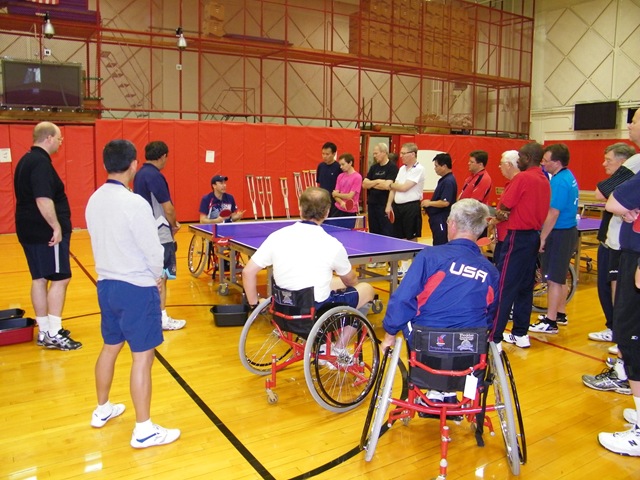
ITTF training pic 1 I was much honored to be selected to attend the first ITTF/IPTTC Level 1 Coaching Certification and Course Conductors Seminar by the USATT Coaches Committee at the U.S. Olympic Training Center in Colorado Springs, Colorado, Sept. 5-11, 2010. Twenty-three table tennis coaches from all experience levels and regions of the USA came to share, learn and to be humbled by Glenn Tepper – the ITTF Executive Director of Development. Mr. Tepper created the structure for the ITTF coaches program and wrote the book, so we were lucky to be learning from the master!

One of the unique parts of this class revolved around the large amount of actual practical application time that was spent by the participants working through the skills and drills included in the book. Mr. Tepper wanted us to  wear both the student and coaches hat nearly all the time so we could not only see the WHAT and HOW but the bigger reason WHY we teach the sport of table tennis the way we do and new ways to approach our teaching.

ITTF training pic 2 Having combined forces with the ITTF, the Para-Table Tennis portion of the   course included an introduction to the classification system for Para-Athletes and a simulation where the coaches participated as different classes of athletes! It was truly an experience to see the various difficulties that are unique to each class and how important the tactics are! Luckily we had Daniel Rutenburg, the USA National Para coach and Christian Lillieroos, long time USA Para coach and PTT board member, to show us the best way to help these unique and inspiring athletes!

Much to Mr. Teppers’ surprise and delight, all 23 of the participants were able to pass the Level 1 practical and meet the standards to pass the educational section of the program. Now we must fulfill the needed application hours to complete the course.

Roger Dickson

My Beginning to Table Tennis Success! by Samson Dubina

Filed under: Samson Dubina — by Jena N. on September 3, 2010 @ 4:55 pm

My coach used the Newgy Robo-Pong table tennis robot to develop my table tennis game early on in my table tennis career. When I was 13 years old and beginning table tennis, some other young table tennis enthusiasts and I were invited to Carl Hardin’s table tennis camp in southern Ohio. One of Coach Hardin’s main teaching tools was the Newgy robot. My strokes were horrendous. I was not sure why I was inconsistent; one of my main problems was that my racket angle was always changing right before contact.

Coach Hardin began having me practice stroking the ball using this consistent robot. He started with slow topspin to my forehand using the slow frequency setting. With this consistency, I learned to keep my racket angle set. If my angle changed, I would hit the ball into the net or off the table.

Another hindrance in my game was my loop against backspin. Throughout the week, I would play against opponents of all levels. When I played against an opponent with heavy chop, I would always loop the ball into the net. Coach Hardin said that I was using the same angle for the topspin stroke as I was for the backspin stroke. I did not believe him. So, back to the Newgy robot we went. With the help of the robot, he showed me that it was nearly impossible to lift the backspin by hitting the top of the ball. By setting my angle more open, I learned to consistently lift any amount of chop. (Note: the most recent chopper I played was rated 2453. I won at 6,4,6. I guess I learned how to loop against chop.)

The first table tennis camp helped my game so much that six months later, I attended my second camp. My strokes were beginning to develop, so Coach Hardin decided to move on to advanced techniques with the Newgy robot. My strokes were much better, but I seemed to be using so much energy for such a weak loop. I needed to learn to accelerate at contact. The robot was the ideal tool. Feeding me consistent topspin, Coach Hardin taught me about speeding-up my racket when I hit the ball. By accelerating the stroke at contact, I was getting more power with half the amount of energy. The robot was perfect for giving me a never-missing, consistent ball to topspin.

Coach Hardin always says that a player’s main focus must be consistency. Ninety percent consistency is a good goal. He would set the robot at random to my forehand, and I had to move and loop the balls with a consistency of 90% on the table. As soon as I achieved this goal, he would immediately increase the frequency. As soon as I accomplished that, he would increase it again. We continued with this type of training to develop speed, without losing control.

Carl Hardin always tried to make table tennis as fun as possible. An added bonus to some of our robot practices was using Pong-Master. Pong-Master is a table tennis game that uses different size pads on the table to be used as targets to hit. Pong-Master also keeps score with the amount of times the player hits the pads. Coach Hardin stressed the fact that, at any level, ball placement is very important. All the young players at the camp enjoyed competing to see who had the best ball control. I was always very competitive, so having a goal to aim at, always inspired me to work harder.

The Newgy robot helped develop my table tennis game into what it is today. Back then, after just two years, Carl Hardin’s coaching techniques raised my game from 1100 to 2100! Using the Newgy robot to develop correct strokes is definitely a winning strategy that I guarantee to raise anyone’s table tennis game!

Samson Dubina