|
|
|||
|
|


UNDERSTANDING SPIN
More so than any other
sport, table tennis is a game of spin. In order to be
successful at table tennis, you must learn about and
understand the different types of spin and how to
counteract the effects of these spins on your racket.
There are two general ways to contact a ball with a
racket. The first is by using force. In other words, the
racket is forced through the path of the ball in a manner
similar to hitting a baseball with a bat. The primary
result of force is forward direction or speed. This is
often the only way that beginners and novice players have
learned to contact a ball.
The second way to contact a ball is by using
friction–to contact the ball with a brushing motion
so the rubber grabs the ball and makes the ball rotate.
The primary result of striking the ball using friction is
spin. The type of spin produced depends on the racket
angle and the direction the racket is traveling.
Top players primarily use friction to contact the ball.
They apply spin to almost every shot, sometimes severe
amounts of spin. Robo-Pong 2000
simulates the play of a top player–it produces spin
on every shot it delivers. Untrained players often
comment that the robot’s spin seems unusually strong.
While this is true for an untrained player, a trained,
competitive player thinks the robot’s spin is quite
normal. So if the spin seems strong at first, bear with
it and you’ll soon adjust by following the suggestions
and lessons later in this manual. Table tennis is much
more exciting and dynamic when you can produce your own
spin and control your opponent’s spin.
The figures below are simple explanations of the four
major types of spins–topspin, backspin, right
sidespin, and left sidespin. Each type of spin has two
figures. The first figure shows what happens when a
particular spin contacts a vertical, still racket. The
second figure shows how to correct your racket angle to
compensate for the effect of the spin on your racket.
Topspin is normally produced by making your racket
travel from low to high while brushing the upper surface
of the ball. Topspin has a dipping effect on the flight
of the ball. For this reason, a ball carrying topspin can
be hit with full force because the spin will cause the
ball to dip down and hit the table instead of going off
the end of the table. When the ball hits the table, the
topspin grabs on the table surface, which both compounds
the dipping effect and slightly increases ball speed.
Topspin is considered to be offensive in most cases.
When topspin strikes a vertical racket, the spin will
grab on the rubber surface and rebound upward, usually
quite high and off the far end of the table. To correct
for topspin and make the ball go back low over the net,
tilt the leading racket face down toward the table and
contact the ball on its upper surface. The more topspin
on the ball, the more the racket needs to be tilted down.
(See Figures G & H )
|
Topspin is produced by racket traveling from low to high, striking the ball on its upper surface. Trajectory is arched. Ball dips after bouncing and rebounds upward after striking a vertical racket. 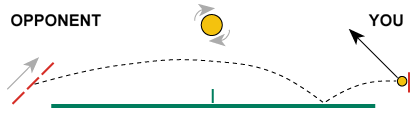
|
|
Since topspin causes the ball to rebound up after contacting a vertical racket, it is necessary to tilt the leading racket face down toward the table and contact the ball on its upper surface. The correct racket angle will send the ball back low to the net. It is not necessary to move the racket forward to make the ball go back across the net. 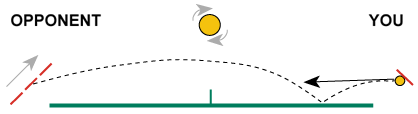
|
|
Backspin is produced by racket traveling from high to low, striking the ball on its lower surface. Trajectory is flat. Ball rises slightly after bouncing and rebounds downward after striking a vertical racket. 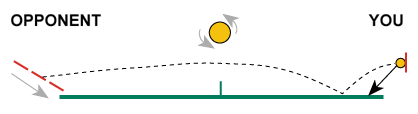
|
|
Since backspin causes the ball to rebound down when it strikes a vertical racket, it is necessary to tilt the leading racket face up toward the ceiling and contact the ball on its lower surface, sometimes actually on its bottom. It is also necessary to add some forward direction to your racket to make the ball go over the net. 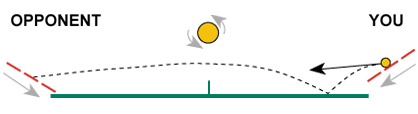
|
An important fact to remember about topspin is it takes almost no effort to counteract its effect on the racket. You only need to angle the racket correctly. The topspin will cause the ball to go back across the net on its own. No force needs to be applied to your racket other than the effort it takes to tilt the racket.
Backspin is generated by making your racket travel from high to low and brushing the ball on its lower surface. Backspin has a floating or rising effect on the ball. When the ball hits the table, the backspin grabs on the table, slowing the ball and making it rise slightly. It’s very difficult use full force when doing a backspin return because the harder you hit it, the more it rises and it tends to sail off the far end of the table. Backspin is almost always considered defensive.
When backspin strikes a vertical racket, the spin grabs onto the rubber and the ball rebounds almost straight down. The ball seems to die and lose all of its speed and spin. To correct for backspin, and make the ball go back low over the net, tilt the racket face up toward the ceiling and contact the ball on its lower surface while pushing the racket gently forward. The more backspin, the more the racket must be tilted up and the more towards the bottom you must contact the ball. (See Figures I & J )
Backspin is unlike topspin in that you must provide some forward momentum to make your return clear the net. It is more difficult and takes more energy to attack a ball with backspin because the ball has a tendency to go down. The lifting action necessary to make the ball clear the net takes away from the amount of forward force you can apply when attacking a backspin ball.In general, a topspin ball will be easier to attack than a backspin one. If you’re a defensive player, backspin should be your spin of choice because it makes it harder for your opponent to attack forcefully.
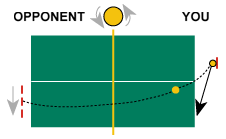
Right sidespin is created when your opponent brushes his racket across the ball from your right to your left. This spin has a curving effect on the flight of the ball. After leaving your opponent’s racket, the ball will momentarily hook to your left, then curve to your right. When it hits the table, the spin grabs, and the ball jumps out and curves to your right.
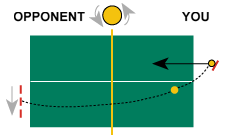
When right sidespin strikes a vertical racket, the spin grabs onto the rubber and jumps quickly to your left. To correct for right sidespin, the leading racket face must be angled to the right and you must contact the ball on its left surface. (See Figures K & L )
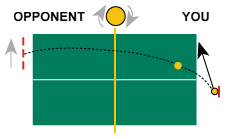
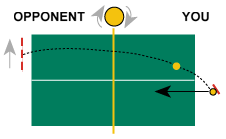
Left sidespin is produced when your opponent brushes across the ball with his racket from your left to your right. Left sidespin is exactly like right sidespin, but in reverse. Left sidespin hooks to your right, then curves to your left. When left sidespin hits a vertical racket, it rebounds to the left. To correct for this spin, angle your racket to the left and contact the ball on its right surface. (See Figures M & N )
Sidespins are seldomly used in their pure form in table tennis. Normally they are combined with topspin or backspin to produce a combination spin such as right sidespin/topspin or left sidespin/backspin. Combining two spins produces the effects of both, but to a lesser degree than if they were in their pure forms.
|
Figure K:Flight
of Right Sidespin Ball
Right sidespin is produced by your opponent’s racket traveling from your right to your left. Trajectory is curved. Ball curves to your right after bouncing. Ball rebounds to your left after striking a vertical racket. |
|
| Figure
L:Correction for Right Sidespin
Since right sidespin causes the ball to rebound to the left when it strikes a vertical racket, it is necessary to tilt the leading racket face to the right and contact the ball to the left of its middle. |
|
| Figure
M:
Flight of Left Sidespin Ball
Left sidespin is produced by your opponent’s racket traveling from your left to your right. Trajectory is curved. Ball curves to your right after bouncing. Ball rebounds to your right after striking a vertical racket. |
|
|
Figure
N:Correction for Left
Sidespin
Since left sidespin causes the ball to rebound to the left when it strikes a vertical racket, it is necessary to tilt the leading racket face to the right and contact the ball to the left of its middle. |
|
For example, a ball with right sidespin/topspin will both dip and curve to the right as it is comes toward you, particularly after it bounces on your side. To correct for this combination spin, it is necessary to contact the ball on its left upper surface by tilting the racket down and angling it to the right.
Understanding spin and its effects is crucial to a player’s success in table tennis. The player with greater mastery of spin will almost always control the play. By using spin, you can limit the responses of your opponent and make him play your game. Two important table tennis skills to develop are:
(1) Be able to instantly judge the type and amount of spin on the ball. Deduce the type of spin by carefully watching the direction that your opponent’s racket is traveling when it contacts the ball. Deduce the amount of spin from the speed of your opponent’s racket at contact and the type of rubber being used. The faster your opponent’s racket is going at contact and the finer his graze of the ball, the more spin he can apply to the ball.
Rubbers vary in their ability to spin the ball primarily because of the grippiness of their top surface. In general, inverted rubber is grippier and will produce more spin than pips-out rubbers. But even within these two broad categories of rubber, the spin producing capabilities of rubber will vary widely. If in doubt, test the grippiness of an unknown rubber by running a ball across its surface and comparing it to your own rubber.
(2) Once you determine the type and amount of spin, be able to instantly adjust your racket angle to correct for the spin’s effect on your rubber. The tension of your grip, the looseness of your wrist, the flexibility of your forearm, and the position of your body all play major roles in developing this important skill.